
- Home
- About us
- Our Products
- Solutions by Industry sector
- HORECA
- News
- Contact us
















How Reliable Is the Result You Trust?
Every day, quality teams make decisions based on test results.
Accept or reject a batch. Approve or halt a process. Investigate or dismiss a potential risk.
The question isn't just whether a result exists. The question is whether that result is actually reliable.
The difference between measuring and trusting
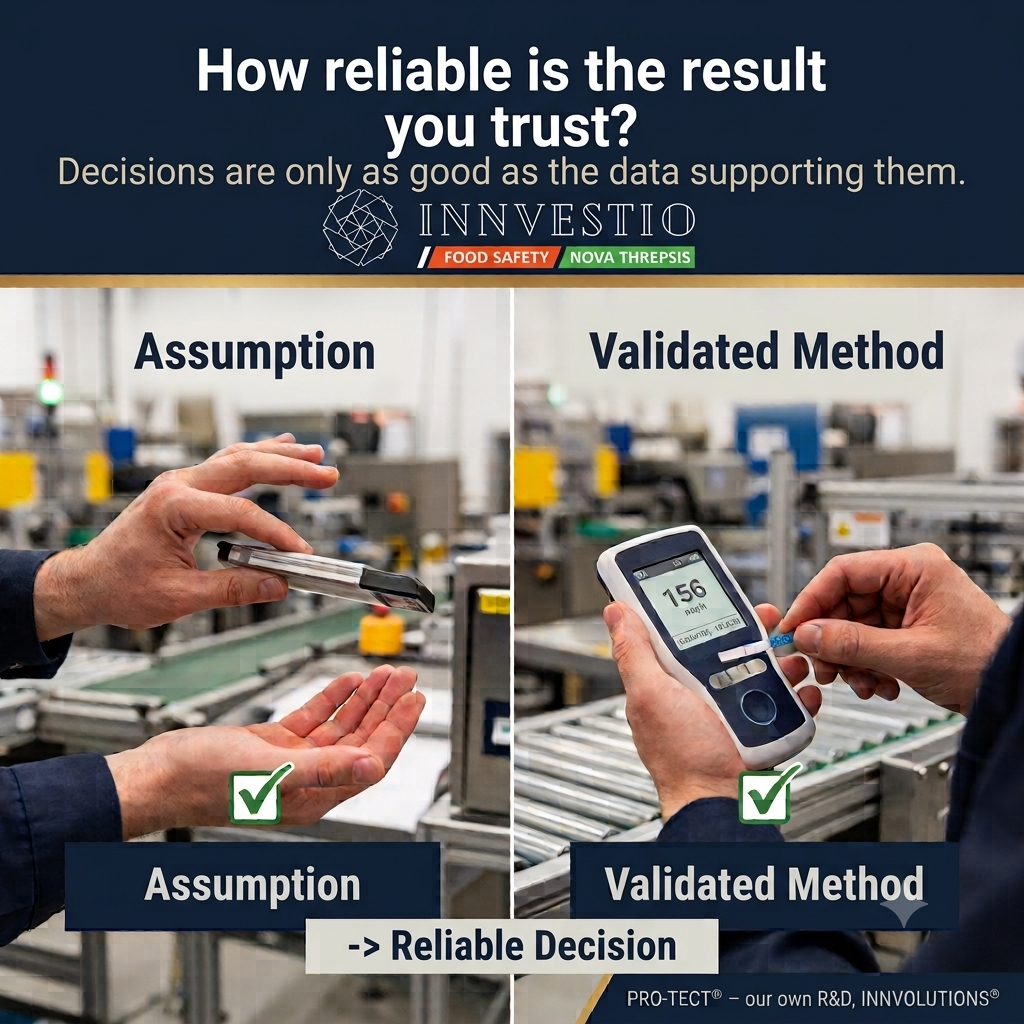
A test gives you a result. A validated method gives you a result you can stand behind. That difference matters the moment it drives an operational or quality decision.
Why validation matters
A method can be fast, easy to use, widely adopted. But the real question is: has it been validated for your specific material, under your actual operating conditions?
Speed answers "when". Validation answers "how reliably".
Decisions are only as good as the data behind them
A result is the starting point of a decision. If the measurement isn't reliable, neither is the decision. That's why the most mature quality teams don't just ask "what did we measure?" They also ask: "how do we know we can trust it?"
We apply the same standard to our own products
PRO-TECT®, developed by our own INNVOLUTIONS®, was designed on exactly this logic: validated for your material and conditions, not just fast. We don't distribute it — we developed it, and we stand behind its validation.
Your next decision will rest on some result.
How reliable is it, really?

- Innvestio Hellas
- Address:Tatoiou 153, Metamorfosi, 144 52 , Attica, Greece
- Phone:(+30) 210 220 6140
- E-mail:[email protected]